Some expenses are infrequent but predictable. An annual subscription, gifts or maintenance may not appear in each month, so they can slip out of an otherwise useful plan. Start with a separate list covering the next year.
Walk through the calendar
Review previous payments and upcoming events. For each entry, note the estimated amount, payment month and money already set aside. Not every past expense will recur; mark the ones you actually expect again.
Separate commitments with known dates, probable expenses and optional plans. They do not have the same priority when the budget cannot cover everything. Where prices may change, record when you last checked the estimate.
An annual average is not a deadline plan
Our annual examples are $600, $360 and $240. Together they total $1,200, or $100 a month when spread evenly over twelve months.
Larger bills, smaller monthly shares
Amounts in US dollars
Annual total divided by 12. Calculate separately for payments due sooner.
An illustrative example. Your changes stay on this page and are not saved.
Open calculatorThat is an average over a full year, not necessarily enough to meet the next payment. If a bill is due in two months and you have nothing set aside, dividing it by twelve will not fund it in time. For that bill, use the remaining amount and the number of contributions before its due date.
Avoid counting the same money twice
Money set aside is still yours, but it already has a purpose. Use a consistent record of transfers between your own accounts and actual purchases. Otherwise you can count the expense once when you set money aside and again when you pay.
A note can hold a simple calculation: “Need $600, have $200, four contributions of $100 left.” When the amount changes, update the arithmetic as well as the description.
Separate the expected from the unexpected
An annual bill with a known date is a planned expense. An unforeseen breakdown is a different situation. You do not necessarily need a separate bank account for every category, but it helps to know what money is for before treating it as available to spend.
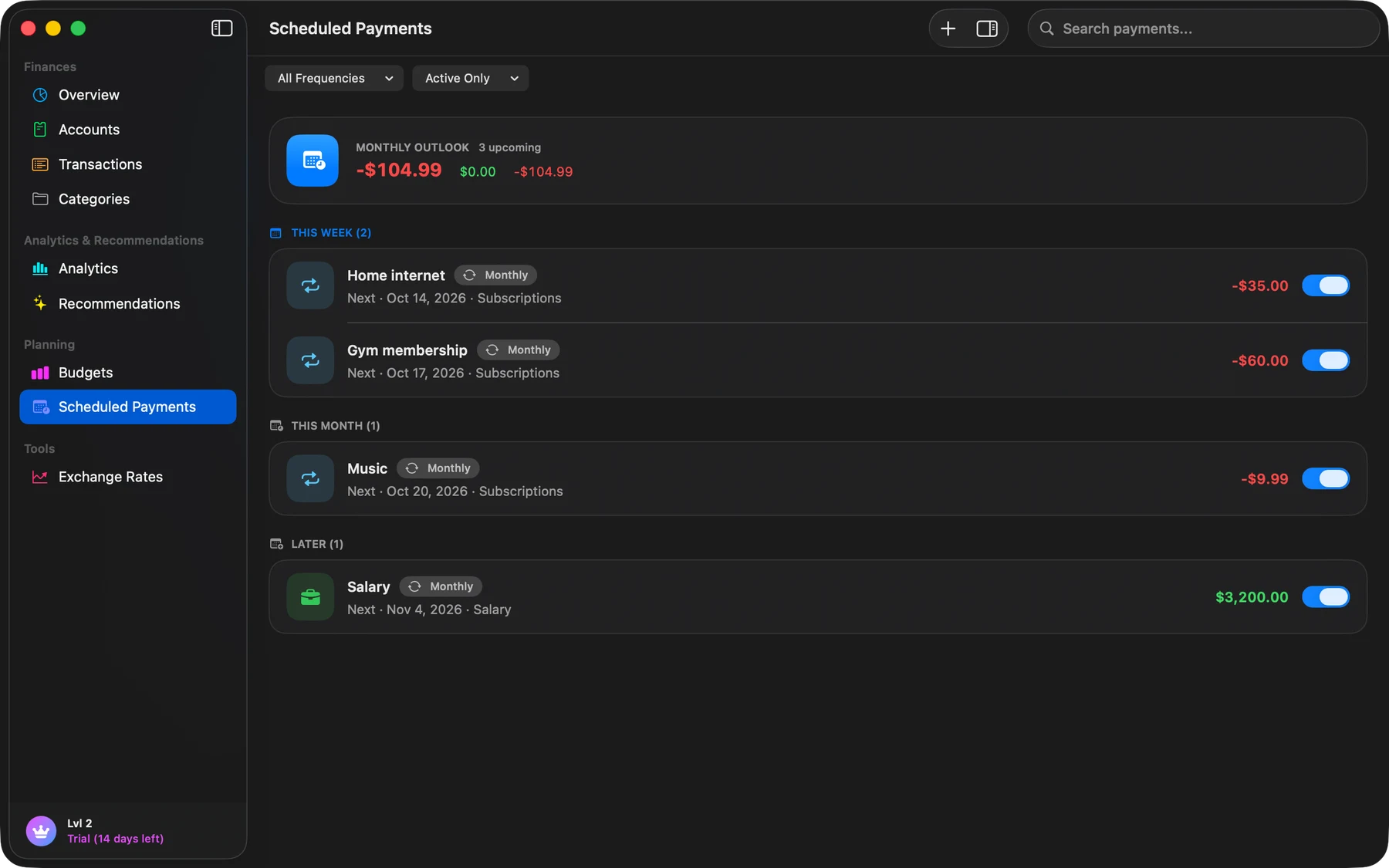
In Finik, you can add planned payments and reconcile them against actual transactions after paying. The financial goal calculator can help calculate contributions towards a particular date. The interactive example here only calculates the annual total and its monthly equivalent.
Review after each payment
Record the actual cost, check whether it is likely to recur and update the next date. Do not automatically copy last year’s price. As the deadline approaches, replace estimates with confirmed amounts where possible.
CFPB: Assess your spending recommends accounting for expenses that do not occur every month. The examples and amounts here are illustrative, not estimates of service prices.